

Teach. Living. Brandenburg.
Around 1,600 new teachers start their careers here every year. You can expect a diverse range of tasks, an attractive working environment and the opportunity to become a civil servant. With meaningful work, you will become part of a modern educational state and help shape the future of our pupils.
Around 1,600 new teachers are recruited every year. These are the best opportunities for a permanent position in the state service, including civil servant status, if the requirements are right. You can also find other interesting offers in the job market in the Education section.

Teach. Live. Brandenburg. is an offer from the Ministry of Education, Youth and Sport of the State of Brandenburg. The state supports prospective, trained or lateral entry teachers on their way to a suitable position in a Brandenburg school.
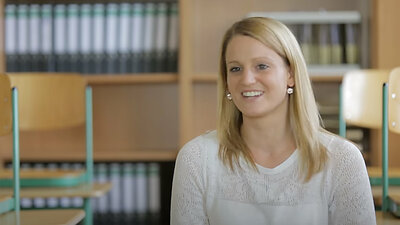
When you open the video, data is transmitted to YouTube. Further information in our privacy policy.
Becoming a teacher in Brandenburg
There are currently 282,020 children and young people learning at 744 public schools, many of which have been newly built or completely renovated. The state employs 21,910 teachers for this purpose.
The school system is divided into 404 elementary school (excluding elementary school at secondary schools and comprehensive schools), 116 secondary schools, 31 comprehensive schools, 79 grammar schools and 73 special schools. For vocational education, there are 25 upper secondary schools (OSZ) with the school-based part of dual vocational training, technical colleges for obtaining the entrance qualification for universities of applied sciences and technical colleges for social work, technology and business. After primary level at elementary school (grades 1 to 6), the further educational path leads to lower secondary level at upper secondary and comprehensive schools (grades 7 to 10) to upper secondary level at comprehensive schools (grades 11 to 13) and grammar schools (grades 11 to 12). The Abitur can be taken after 13 years at comprehensive schools and vocational grammar schools (OSZ) and after 12 years at grammar schools.
Berlin is closely intertwined with Brandenburg. We want a common educational area between Berlin and Brandenburg. That is why the curricula of the two states have been closely interlinked. As a result, there has been a joint framework curriculum for grades 1 to 10 since the 2017/18 school year.
Photo: virojt/iStock